Sunday, 12 December 2010

coluring pages

Click on the picture you want to color
This will bring up a larger image which you can print to color.
To do this, choose "print" from your menu bar to print out the picture.
Hit the "Back" Button on your browser to return here.

dancer
Dancing Frog
new swimmer
New Swimmer Froggy
red-eye
Red-Eyed Tree Frog
firebelly
Firebellied Toad
berry climber
Berry Climber
tree frog
Tree Frog
Rainy Day Froggy
Rainy Day Froggy
Poison Dart Frogs
Poison Dart Frogs
Lily Frog
Lily Frog

sent in by Tom
bath time froggy
Bath Time Froggy
There are also some fun Froggy Valentines Day Cards
for you to print, color, and cut out to give to your friends
in the Valentine's Day Fun page!

hear are a fuw things to help frogs

Here are some simple ideas to help you get involved at home and in your community.
Create some space for wildlife
  • Plant a tree in your backyard.
  • Build a pond for the neighborhood frogs.
  • Start composting in your backyard garden or on your balcony. It eliminates the need for chemical fertilizers which are harmful to animals and humans, and it benefits your plants!
  • Don't to use harmful chemicals in your garden or home.
Reduce, recycle and reuse
  • Find alternatives to pesticides and ozone-depleting chemicals in your home and workplace.
  • Recycle your toys, books and games by donating them to a hospital, daycare, nursery school or children's charity. This way the same toys can make more than one person happy!
  • Save energy by turning off lights, radios and the TV when you are not using them.
  • Turn off the tap while you brush your teeth and use water-saving devices on your toilet, taps and showerhead.
  • Encourage your family to take public transportation. Walk or ride bicycles rather than using the car. When you can, try to organize carpools. This will help cut down on harmful fumes and unnecessary use of our earth's resources.
  • Buy products and food without packaging whenever possible. Take your own bag to the store. It will reduce the amount of garbage and waste your family produces.
  • Encourage your family to shop for organic fruits and vegetables.
Start garbage free lunches
  • Bring a lunchbox or a cloth lunch bag.
  • Use a thermos and reusable containers.
  • Start a recycling program at school.
  • Encourage your cafeteria to use re-useable containers and recycled paper napkins.
  • Sell coffee mugs to replace wasteful paper and styrofoam cups. Then donate the money to help protect the environment.
Share your concerns
  • Start an environment club. You can hold special environment weeks and events.
  • Write to your local, provincial and federal government representatives to encourage them to help conserve wetlands and other amphibian habitats.
  • Write and perform a play or make a video to tell others about our endangered species.
  • Arrange for a local naturalist or birdwatcher to speak to your class or to take your group on a nature walk.
  • Have your school adopt a part of the Earth. Plant native trees and shrubs on your school grounds or clean up a nearby stream or park with the help of local naturalist clubs.
Protect an Acre of the World's Vanishing Wilderness
    Between 50 and 80% of all the plants and animals in the world live in the tropics. New species of frogs are discovered in the tropics all the time. Yet, every second more than an acre of tropical forest disappears. The trees are chopped down for re-sale, and what's left gets burned. Sometimes even this remaining land gets flooded by dams built for electricity or waterways. Our planet is losing huge amounts of rich habitat, home to millions of unique species and local peoples.With their homes being cut down, many species are become endangered. It's been estimated that every hour, one species has completely dissapeared form the Earth! Scientists and environmental action groups are trying to work with local rainforest peoples to develop alternatives to "slash and burn" agriculture, so that they can grow food and support themselves without having to destroy more forest. Our own lifestyle choices have an impact on tropical habitats. We can also reduce demand for unsustainable rainforest products by being careful about what we buy. You can also make donations to one of the various Wildlife Conservation groups to adopt an acre of endangered forest and help conserve amphibian populations.
Other Cool Frog Projects:
  • Frog Force Campaign - a new initiative spearheaded by the Department of Interior and National Wildlife Federation, join in the campaign to raise awareness of the plight of frog species.
  • Frog Spotting Visit a local pond to hear the spring peepers, bullfrogs and other frog species singing love songs to each other.
  • A Thousand Friends of Frogs - connects K-12 students, educators, families, and scientists from Minnesota and beyond to study and celebrate frogs and their habitats.
  • Frogwatch USA USGS has launched Frogwatch USA fo conduct long-term frog and toad monitoring. Frogwatch aims to engage everyday people in conservation & having fun!
  • Rainforest Alliance Frog Pond Great teaching tool website with fun stuff for learning.

cold weather frogs

Frogs that live in cold regions can't be active year round. When the weather gets cold their bodies cool down and they can't move.
As the temperature drops, frogs burrow a little ways under forest leaves (so they won't freeze to death), and go into hibernation until the weather gets warm again.

Brrrr!!! It's c-o-l-d outside!!

woodfrogWood frogs, like this one on the right, are the most widely found frogs above the Arctic Circle. In the winter it can get so cold that you would probably rather be at home with a cup of hot cocoa! These frogs have found some very interesting ways to adapt to this cold weather.
When the temperatures start to drop, Wood Frogs will go buries itself and then shuts itself down. As the temperatures get harsher, the frogs create glucose in their liver by breaking down glycogen using enzymes. This glucose goes out into their body organs and is distributed throughout the bloodstream.
The Wood Frogs are one of serveral species that have the amazing ability to completely freeze solid! (Peepers can do the same...except that in their case they have lots of glycerol, not glucose, in their system)
Since there's so much glucose in the Wood Frog's system, their organs don't get damaged because the sugar in their blood acts as anti-freeze. They can stay completely frozen like that for 2 weeks or more. They stay frozen for as long as the temperature of the ground is below freezing. They have no choice. They are the exact temperature of the environment they are in. When they thaw out, it's like an icecube coming to life!
The first thing that happens when they thaw is the heart starts beating again. Then they start gulping air and shaking out their limbs. Finally, the when the frog is fully recovered, he can hop away!
Why is this important? Just think what it could mean for people if we could develope drugs that do the same thing for humans! "Needs a heart transplant? No hearts available?? Okay, give him 500cc's of froggie coolaid and throw him in the cooler!"
And you'd never guess what the first thing these frogs want to do when they thaw out is!
No, not breakfast - they go find the nearest breeding ponds!! In fact, these guys are known as very explosive breeders.
The term "explosive" refers to the duration of their breeding activity. The woodfrog breeds only for a few short nights, sometimes only one night! This is contrast to the breeding duration of say the Green Frog (R. Clamitans) whose breeding season is 2-3 months!
(I guess that would explain why they'd be in such a hurry to get to that breeding pond)
Nor are these guys particluarly picky! ANY pool of water will do (Even if it's not completely thawed water yet or if its just a puddle!) 

desert frogs


[image]The Catholic frog (Notaden bennetti) is a yellow or greenish Australian myobatrachid which gets to be about 4 cm (1.5 inches) long. It was named for the dark, crosslike pattern on its back, and it lives in dry regions. The way it copes with drought is to live underground, emerging from its burrow after a heavy rain.


Another desert dweller is the Flat-headed frog (Chiroleptes platycephalus) which is also an Australian myobatrachid. It, too, lives in burrows and is noted for its' ability to store enough water in its body to take on a ball-like shape. *bloat*


super skin


Frogs have very special skin! They don't just wear it, they drink and breathe through it.
Frogs don't usually swallow water like we do. Instead they absorb most of the moisture they need through their skin. waterfrog
Not only that, but frogs also rely on getting extra oxygen (in addition to what they get from their lungs) from the water by absorbing it through their skin. Because frogs get oxygen through their skin when it's moist, they need to take care of their skin or they might suffocate. Sometimes you'll find frogs that are slimy. This is because the frog skin secretes a mucus that helps keep it moist. Even with the slimy skin, these frogs need to stay near water. Toads on the other hand have tougher skin that doesn't dry out as fast, so they can live farther from water than most frogs.
In addition to jumping in water, frogs and toads can get moisture from dew, or they can burrow underground into moist soil.
Frogs shed their skin regularly to keep it healthy. Some frogs shed their skin weekly, others as often as every day! This looks pretty yucky...they start to twist and turn and act like they have the hiccups. They do this to stretch themselves out of their old skin! Finally, the frog pulls the skin off over it's head, like a sweater, and then (this is gross) the frog EATS IT!!!! (EEEEEWWW!) 


do frogs have teeth ???????

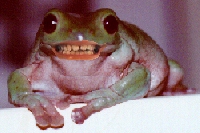
frog with big teeth!Actually, yes! But not like in this silly picture!
Most frogs do in fact have teeth of a sort. 
They have a ridge of very small cone teeth around the upper edge of the jaw. These are called Maxillary Teeth.
Frogs often also have what are called Vomerine Teeth on the roof of their mouth. 
They don't have anything that could be called teeth on their lower jaw, so they usually swallow their food whole. The so-called "teeth" are mainly used to hold the prey and keep it in place till they can get a good grip on it and squash their eyeballs down to swallow their meal.
Toads, however, do NOT have any teeth.

Saturday, 11 December 2010

name your best frog

name your best frog and i will pick one and put it on the frunt screen for every one to see.
to give you ideas look at the link.